PresentationTimer

Toastmasters timer

Toastmasters Timer for Green, Yellow, and Red Speech Signals

Run a speech timer the speaker can see. The timer keeps Host or Operator controls. Display stays read-only through Table Topics, prepared speeches, and evaluations.

Green / yellow / red
Speaker display
Timer keeps control
See how it works
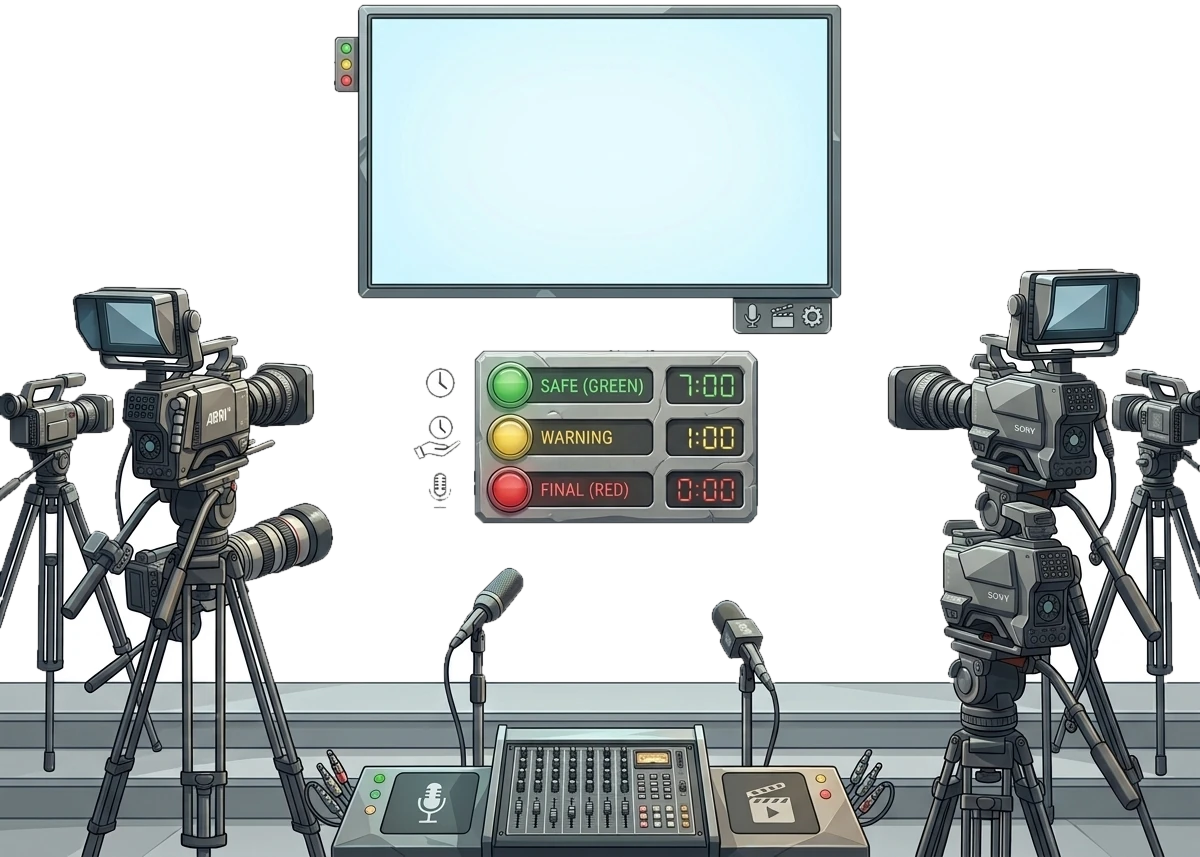
Studio cameras and a mixer desk facing a speaker display with green, yellow, and red remaining-time cues

Real club situations

Paper cards fail when the speaker cannot see the timer.

A Toastmasters timer is not only a stopwatch. It is the signal between the timer, the speaker, and the room.

Paper cards work in a small room if the speaker looks over. They disappear on a hybrid camera. A phone timer stays in the timer's hand. A laptop app shared into Zoom often shows Host buttons the speaker should never touch.

a prepared speech with a 5-7 minute window and a 30-second grace period
Table Topics where each speaker needs a 1-2 minute signal the room can see
evaluations that must stay inside a 2-3 minute slot before the next speaker
a hybrid meeting where the in-room speaker cannot see paper cards on camera
an online club night where screen-sharing the timer laptop also shares the controls
a timer report that needs a clear overtime record instead of a stopped stopwatch

Remaining-time cues

Map club times to Yellow, Red, and overtime. Do not copy paper cards blindly.

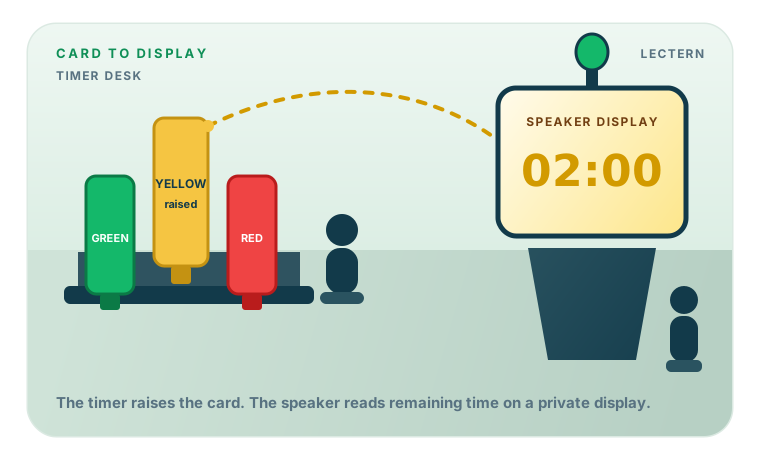
A timer desk with green, yellow, and red paddles, mapping a raised yellow card to a lectern speaker display at 2:00 remaining

PresentationTimer colors are remaining-time states. Green is safe time. Yellow and Red are thresholds you set. Overtime begins at 0:00 and stays on screen.

Paper cards are elapsed-time signals: on a 5-7 minute speech, green is often shown at 5:00, yellow at 6:00, and red at 7:00. PresentationTimer changes color by time remaining. Set duration to the maximum, then set Yellow to the first cue the speaker must notice, usually the green-card moment.

Confirm times with your club. The examples below are common 1-2, 5-7, and 2-3 minute windows, not a substitute for club guidelines.

Keep sound on the timer's device. Use Display or Speaker view for the visual signal so a chime does not play through the meeting microphone.
Example remaining times

Set duration to the maximum. Set Yellow and Red as remaining time.

SegmentCommon club windowTimer durationYellow remainingRed remaining
Table Topics1-2 minutes2:001:00 remaining0:30 remaining
Prepared speech5-7 minutes7:002:00 remaining1:00 remaining
Evaluation2-3 minutes3:001:00 remaining0:30 remaining

On a 7:00 prepared speech, Yellow at 2:00 remaining is the usual green-card moment, so the display turns yellow when clubs would raise green. Red at 1:00 remaining is the usual yellow-card moment. Overtime at 0:00 is the red card and the grace window. A new timer defaults to Yellow at 2:00 remaining and Red at 0:30 remaining; change those values to match the speech you are timing.

Why PresentationTimer

Give the speaker a display. Keep the clock with the timer.

The speaker should not manage the clock while speaking.

The timer should not have to wave cards the camera cannot see, or share a laptop that also shows Start, Pause, and settings.

PresentationTimer splits those jobs: Host or Operator for control, Display or Speaker view for the signal.

A speaker display the room can actually see

Paper cards only work if the speaker looks at the timer. A read-only Display or Speaker view can sit on a lectern screen, projector, second laptop, or phone so the speaker follows remaining time without holding the clock.

The timer keeps control. The speaker does not.

Host and Operator start, pause, reset, and switch speeches. Display and Speaker views stay read-only, so a speaker never gets the Host link and never sees editing controls.

Green, yellow, red, and overtime stay on screen

Set Yellow and Red remaining-time thresholds on each speech. When the timer reaches 0:00, overtime stays visible through the grace window instead of disappearing into a blank stopwatch.

How it works

Set up a Toastmasters timer room in four steps.

Create the room, set the three speeches, share a read-only display, and start each speaker from Host or Operator.

Leave Linked Start off unless the next item should start by itself when the previous timer hits 0:00.

1

Create a timer room

Open PresentationTimer and create a free room. Keep the Host link with the timer. Operator View can run live start, pause, and switch from a phone or tablet.

2

Add Table Topics, prepared speech, and evaluation

A Free room holds three timers. Set each duration to the maximum time for that segment, then set Yellow and Red remaining times to the points your club uses for wrap-up and the final stretch.

3

Open Display for the speaker, never Host

Put Display or Speaker view on the lectern, projector, or the speaker's phone. In an online meeting, share only that read-only view. Do not screen-share Host.

4

Start each speech from Host or Operator

The timer starts the next speaker. Use Linked Start only when the next item should start automatically at 0:00. Leave it off when the next speaker still needs a manual cue.

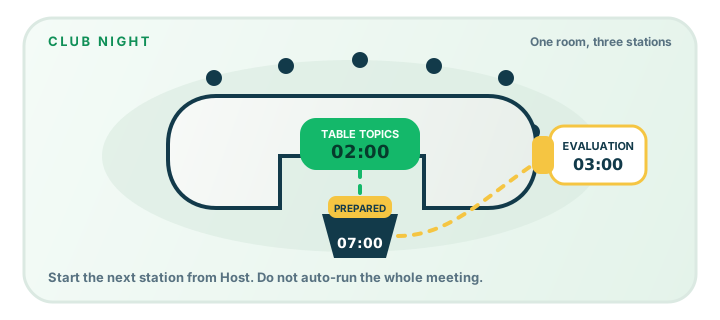
A club-night floor plan with Table Topics at the table, a prepared speech at the lectern, and evaluation at a side seat

Agenda in one room

Table Topics, prepared speech, and evaluation stay in one room.

A Free room holds three timers. That matches a typical club block: Table Topics, one prepared speech, and evaluation.

Start the next speech yourself. Linked Start is for a handoff that should run automatically, not for a whole meeting where each speaker still needs a cue from the timer or Toastmaster.

Need a wider speaking workflow outside a club meeting? Use the speech timer page.

Role views

One meeting, four timing views.

The timer needs controls. The speaker needs a cue. The room needs a readable clock. Those are different links from the same room.

Timer / Host

Creates the room, sets durations and remaining-time cues, and keeps the Host link private. This is the workspace for editing the agenda.

Operator

Starts, pauses, resets, and switches the live speech from a phone or tablet without opening Host's full workspace.

Speaker

Sees the current speech, remaining time, color state, and the next segment on a personal read-only view. There are no start or edit controls.

Display

Shows a clean countdown on a lectern, projector, second laptop, or meeting screen share. The audience can see time without seeing Host controls.

Comparison

Use a speech timer the speaker can follow, not only a clock the timer can hold.

Paper cards

Clear in a small room if the speaker looks at the timer. Easy to miss on camera, in a hybrid meeting, or when the speaker faces the audience.

Phone stopwatch

Private to the timer. The speaker cannot see remaining time, and overtime disappears the moment the timer stops the clock.

Local timer app

Useful on one laptop, but it usually mixes controls and display. Screen-sharing that window shows buttons the speaker should never touch.

PresentationTimer

A speech timer with private Host or Operator control, a read-only speaker display, remaining-time color cues, visible overtime, and three agenda timers in one room.

Ready to time a club speech?

Create a free room, share the speaker display, and keep Host with the timer.

Set Table Topics, a prepared speech, and evaluation. Open Display where the speaker can see it. Start each speech from Host or Operator.

Overtime stays visible through the grace window, so the timer report is not a guess.

FAQ

Toastmasters timer questions

Can the speaker see this speech timer during a Toastmasters meeting?+

Yes. Open Display on a lectern screen, projector, second laptop, or meeting screen share, or send Speaker view to the speaker's phone. Those views are read-only. Keep the Host link with the timer.

How do green, yellow, and red cards map to PresentationTimer?+

PresentationTimer uses remaining-time states, not paper cards. On a 5-7 minute speech, clubs often raise green at 5:00 elapsed, yellow at 6:00, and red at 7:00. Set duration to 7:00, Yellow to 2:00 remaining for the green-card moment, and Red to 1:00 remaining for the yellow-card moment. Overtime at 0:00 is the red card and the grace window.

Can one room time Table Topics, a prepared speech, and evaluation?+

Yes. A Free room can hold three timers, which is enough for Table Topics, one prepared speech, and evaluation. Start the next speech from Host or Operator. Do not turn on Linked Start for the whole meeting unless the next item should start automatically at 0:00.

Should I send the Host link to the speaker?+

No. Host can start, pause, edit, and change the room. Speakers should open Display or Speaker view only. Operator View is for the timer on a phone or tablet, not for the speaker.

What if the club meets online and there is no projector?+

Share the Display link in the meeting window, or ask the speaker to open Speaker view on a second device. Do not share the Host window. Keep sound cues on the timer's device so a chime does not blast through the meeting microphone.

Does overtime cover the 30-second grace window?+

Yes. After 0:00 the timer keeps running in overtime instead of going blank. The timer can still see how far past the limit the speech ran when writing the timer report. Confirm grace rules with your club.

Does the audience see Host controls?+

Not if you share Display. Display shows the active countdown, warning colors, and optional message. Host controls, settings, and editing stay on the timer's private page.

Is this Toastmasters timer free?+

Yes. You can create a free speech timer room in the browser. Free rooms include three timers and five connected devices, which is enough for a timer plus Display, Speaker, and Operator views.